

CHECK OUT: Death is but a Dream

Dear Friends,
You must add Death is but a Dream – Finding Hope and Meaning in Life’s End by Christopher Kerr, MD, PhD to your must-read list. I initially heard Dr. Kerr on CBC Radio. He is originally from Canada and is now practicing as a hospice doctor in the USA. He completed a residency in internal medicine, began a fellowship in cardiology while working as a hospice doctor to help pay his bills. Dr. Kerr states he knew close to nothing what it meant to be a doctor of the dying. He was amazing to listen to! Right way, I looked up his book and am so happy to have read it.
Dr. Kerr explains that his first exposure to death was at the age of 12 when his father died. He tells of his experience, which sadly was not the best due to the way things were handled back then. This would impact him for the rest of his life. We have both experienced this personally and through our careers. He followed the same career path as his father and became a doctor.
Dr. Kerr refers to medical school as a place where death is rarely mentioned let alone the experiences patients have leading up to it. Medical training is about defying death and if death cannot be defied, then it is essentially denied. Critically ill patients are abandoned as there is nothing more to diagnose or treat. One day, he would come to realize at there is a lot left that we could do. He writes, “we can resurrect the lost art of bedside medicine and care for those who are dying by being present and relieve suffering, which entails more than just pain management when a cure is not achievable.” Finally, a doctor who thinks like I do!
As Dr. Kerr states, “Today we live with a death-avoidance model of care that is inadvertently reinforced by a fee-for-service health care marketplace based on outputs rather than outcomes, volume rather than value….By its very design, our system is often unable to recognize dying patients who may simply need attention in the form of presence, care and comfort, not acts of doing or billable interventions….We know we have a problem on our hands when the majority of people claim not to want to die in an institution yet most of them do.” This is a topic we both have discussed so often….” the economics of medicine!” Working in hospice allowed Dr. Kerr to “reconnect with a more humanist medicine.”
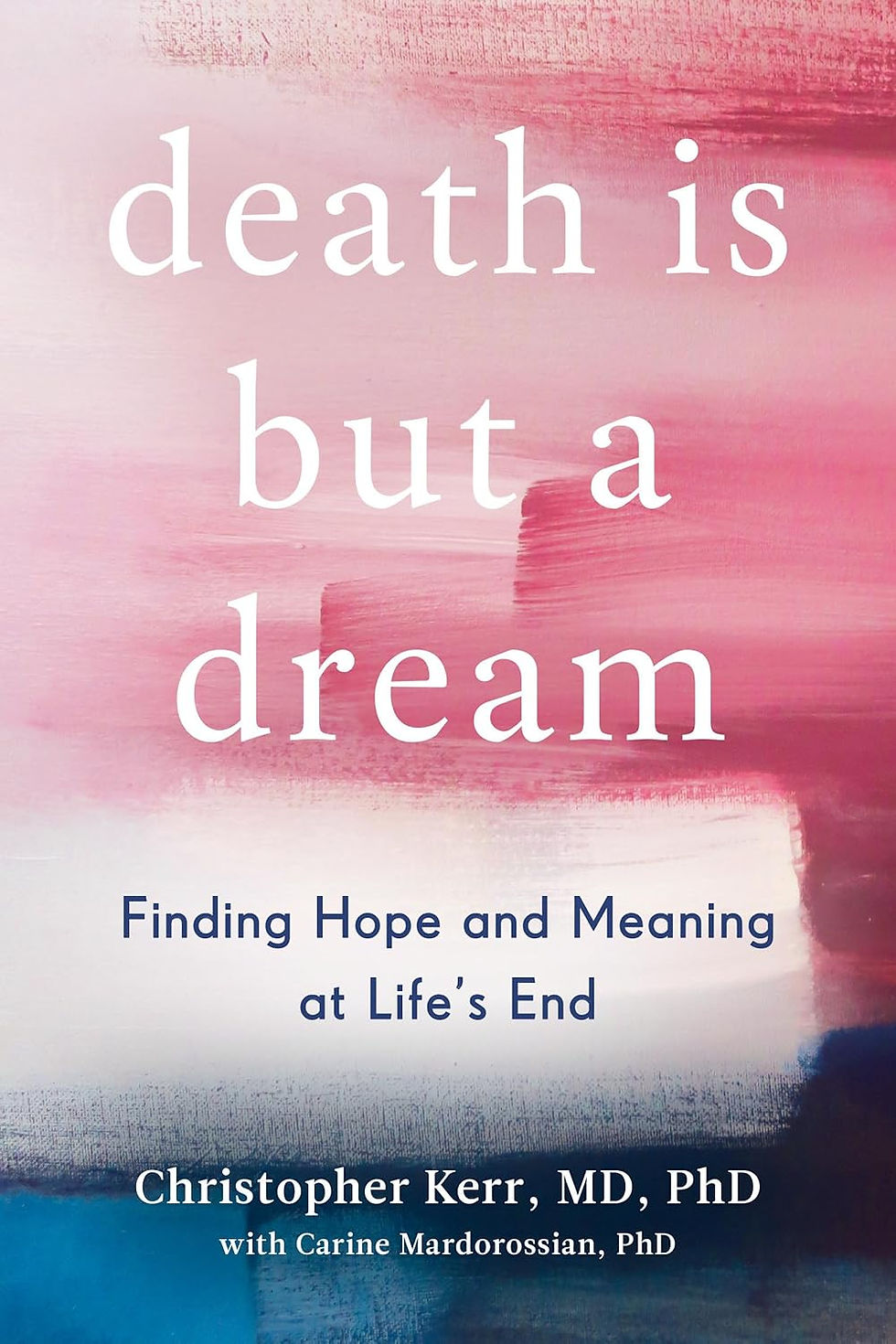
Dr. Kerr found it interesting when patients shared their end-of-life experiences, which he did not “mistake for confusional states, consequence of disease or medicine-induced hallucinations.” There was “little medical literature to substantiate the dying patient’s experience.” As you may know, there is a little amount offered in medical training about death. In the book, Dr. Kerr reviews multiple patients with end-of-life experiences and how it affects them, their families and the health care team. He brings normalcy to end of life experiences. I will not go into detail about these experience (and there are many), but I guarantee you will definitely have an “ah ha” moment as you read.
Dr. Kerr states “I have witnessed again and again the quiet process of peaceful surrender and well-being, the version of grace and spirituality that takes my patients over the threshold of pain and suffering….There is no detaching human beings from the biological realities of dying. It takes vast courage and resilience to face one’s death or the gaze of others on one’s disease. My patients’ pre-death dreams and visions are a visible manifestation of this inner strength. They help the dying reunite with a more authentic sense of self, with the people they have loved and lost, those who secured them and those who have brought them comfort and peace. Their needs are addressed.”
In summary, Dr. Kerr states he wrote the book because there is something to be said about the dying process, that dying is more than the suffering we either observe or experience and a time of transition that triggers a transformation of perspective and perception. “Dying is an experience that pulls us together by binding us to those who loved us from the start, those who we lost along the way, and those who returned to us in the end.” The book is “rooted in studies that were conducted by a talented group of researchers from Hospice Buffalo.”

Comments